
PREGNANCY DISCRIMINATION








Pregnancy Discrimination in the Workplace: West Virginia and Ohio
Finding out you are pregnant should be a time of anticipation, not anxiety about losing your job. Yet pregnancy discrimination remains widespread — employers fire, demote, refuse to hire, deny promotions to, and push out pregnant employees and new mothers at alarming rates. Federal and state laws provide strong protections against pregnancy discrimination in the workplace, and those protections have expanded significantly in recent years. At Klie Law Offices, our employment law attorneys represent workers throughout West Virginia and Ohio who have experienced pregnancy discrimination and help them enforce their rights and recover damages.
We handle pregnancy discrimination cases from our offices in Buckhannon, Clarksburg, Morgantown, Parkersburg, and Canton, Ohio.
Laws That Protect Pregnant Workers
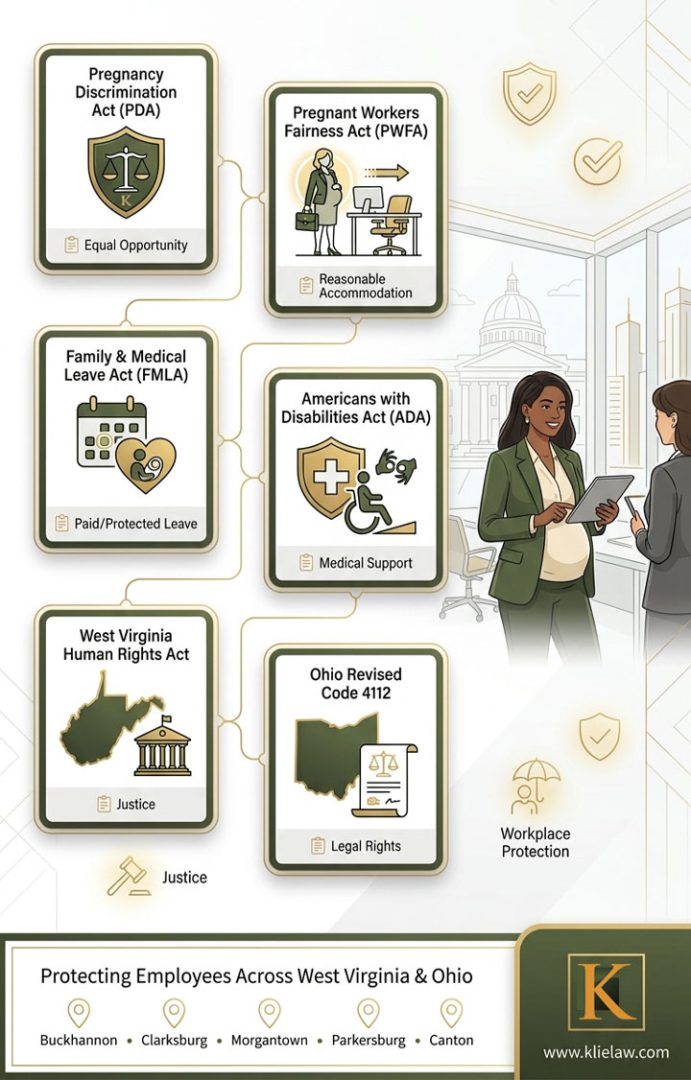
Pregnant employees are protected by multiple overlapping federal and state laws, each providing different rights and remedies. Understanding which laws apply to your situation is important because the protections vary in scope.
Title VII and the Pregnancy Discrimination Act
The Pregnancy Discrimination Act of 1978 amended Title VII of the Civil Rights Act to make clear that discrimination based on pregnancy, childbirth, or related medical conditions is a form of illegal sex discrimination. Under the PDA, employers with 15 or more employees cannot refuse to hire a woman because she is pregnant, fire or demote a woman because she is pregnant, force a pregnant employee to take leave if she is still able to work, deny a pregnant employee the same benefits available to other employees with similar abilities or limitations, or treat a pregnant employee differently from other employees who are similar in their ability or inability to work.
The Pregnant Workers Fairness Act
The Pregnant Workers Fairness Act, which took effect in 2023, significantly expanded protections for pregnant employees. The PWFA requires covered employers (those with 15 or more employees) to provide reasonable accommodations for known limitations related to pregnancy, childbirth, or related medical conditions — unless the accommodation would impose an undue hardship on the employer. This was a major advance because, prior to the PWFA, pregnant employees often fell into a gap between the PDA and the Americans with Disabilities Act, where they needed accommodations but did not qualify for them under existing law.
Reasonable accommodations under the PWFA may include more frequent or longer breaks, permission to sit or stand as needed, modified schedules for prenatal appointments, temporary reassignment to less strenuous duties, light duty assignments, temporary suspension of certain job requirements, time off for recovery from childbirth, and telework when feasible. The employer must engage in an interactive process with the employee to identify effective accommodations and cannot require the employee to take paid or unpaid leave if another reasonable accommodation is available.

The Family and Medical Leave Act
The FMLA provides eligible employees with up to 12 weeks of unpaid, job-protected leave for the birth of a child and to bond with the newborn, as well as for serious health conditions related to pregnancy. While the FMLA does not require paid leave, it guarantees job protection and the continuation of health insurance benefits during the leave period.
The Americans with Disabilities Act
While pregnancy itself is not a disability under the ADA, pregnancy-related medical conditions can be. Conditions such as gestational diabetes, preeclampsia, severe morning sickness, and pregnancy-related sciatica may qualify as disabilities under the ADA's broad definition, entitling the employee to reasonable accommodations. The ADA's protections supplement those of the PWFA and may cover employees whose employers are not subject to the PWFA.
West Virginia Human Rights Act
West Virginia's Human Rights Act explicitly prohibits discrimination based on sex, which includes pregnancy discrimination. The Act applies to employers with 12 or more employees and provides for compensatory and punitive damages without the caps that apply to federal Title VII claims, making it a powerful vehicle for pregnancy discrimination claims in state court.
Ohio Revised Code Chapter 4112
Ohio's anti-discrimination statute prohibits pregnancy discrimination and applies to employers with four or more employees — broader coverage than the federal laws. Ohio courts have recognized pregnancy discrimination claims under both disparate treatment and failure-to-accommodate theories. Our Canton office attorneys are experienced in pursuing pregnancy discrimination claims under Ohio law.
Common Forms of Pregnancy Discrimination
Pregnancy discrimination manifests in many ways, some overt and others more subtle. Recognizing these patterns is the first step in protecting your rights.
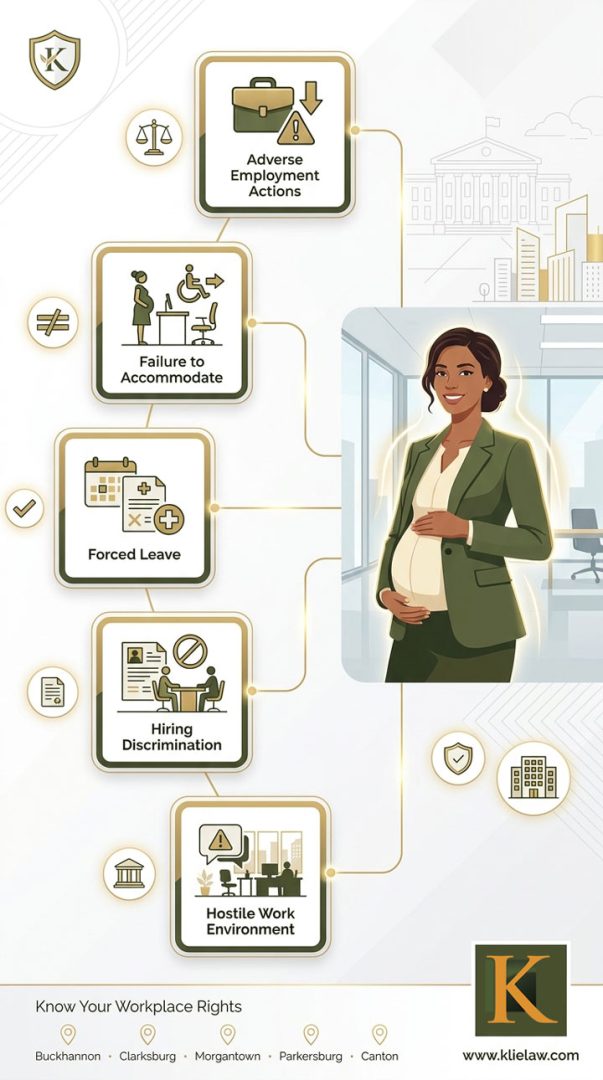
Adverse Employment Actions
The most straightforward form of pregnancy discrimination occurs when an employer takes a negative employment action because of the employee's pregnancy. This includes termination, demotion, reduction in pay or hours, denial of promotion, unfavorable transfer, exclusion from training or advancement opportunities, and negative performance evaluations that do not reflect actual performance. Employers rarely admit that pregnancy motivated the decision — instead, they offer pretextual reasons that an attorney can help you challenge.
Failure to Accommodate
Under the PWFA, refusing to provide reasonable accommodations for pregnancy-related limitations is illegal. Common accommodation failures include refusing to allow more frequent bathroom breaks, denying requests for temporary light duty even though light duty is available for other conditions such as workplace injuries, requiring pregnant employees to maintain physically demanding duties despite medical restrictions, and refusing to modify schedules for prenatal appointments.
Forced Leave
Some employers force pregnant employees to begin leave earlier than medically necessary, often citing safety concerns or company policy. Under the PWFA, an employer cannot require a pregnant employee to take leave — paid or unpaid — if another reasonable accommodation would allow her to continue working. The decision about when to begin leave should be the employee's, in consultation with her health care provider, not the employer's.
Hiring Discrimination
Employers cannot refuse to hire a qualified applicant because she is pregnant or might become pregnant. Questions about pregnancy status, family planning, or childcare arrangements during the hiring process are red flags for discrimination, and basing a hiring decision on these factors is illegal.
Hostile Work Environment
Persistent comments, jokes, or negative remarks about an employee's pregnancy, body changes, anticipated absences, or commitment to the job can create a hostile work environment based on pregnancy. When this conduct is severe or pervasive enough to alter the employee's working conditions, it constitutes illegal harassment.
Client Reviews
























Pregnancy Discrimination and Retaliation
Employers cannot retaliate against employees for asserting their pregnancy-related rights. If you requested an accommodation, filed a complaint about pregnancy discrimination, or opposed discriminatory treatment, and your employer subsequently fired, demoted, or otherwise punished you, you may have a retaliation claim in addition to your discrimination claim. Retaliation is independently illegal and can result in additional damages.

Building a Pregnancy Discrimination Case
If you believe you have experienced pregnancy discrimination, documentation is critical. Keep records of when you disclosed your pregnancy to your employer and how they responded, any accommodation requests you made and the employer's responses, changes in your treatment, assignments, or evaluations after disclosing your pregnancy, comments by supervisors or coworkers about your pregnancy, the timeline of any adverse employment actions relative to your pregnancy disclosure, and how the employer treated other employees with similar limitations who were not pregnant.
Comparator evidence — showing that the employer treated similarly situated non-pregnant employees more favorably — is often critical in pregnancy discrimination cases. If your employer provided light duty for employees with workplace injuries but denied it to you during pregnancy, that disparity is powerful evidence of discrimination.
Helpful Shorts From Our TikTok
Klie Law Office F.A.Q
1. What should I do immediately after a personal injury accident?
After a personal injury accident, your safety comes first. Seek medical attention right away, even if you feel fine, as some injuries may not be immediately apparent. If possible, document the scene by taking photos, gathering witness information, and filing an accident report. Then, contact an experienced personal injury attorney at Klie Law Offices to discuss your rights and next steps.
2. How do I know if I have a valid personal injury claim?
If you were injured because of someone else’s negligence or reckless actions, you may have a valid personal injury claim. Common situations include car accidents, slip and falls, workplace injuries, and dog bites. Our attorneys offer free consultations to review your situation and determine whether you have a case.
3. How much is my personal injury case worth?
The value of a personal injury case depends on several factors, including the severity of your injuries, medical expenses, lost wages, pain and suffering, and long-term impacts on your life. Every case is unique, so we carefully evaluate the details to pursue the maximum compensation available under the law.
4. Will my personal injury case go to court?
Most personal injury cases are settled outside of court through negotiations with insurance companies or at mediation. However, if a fair settlement cannot be reached, Klie Law Offices is prepared to represent you in court and fight for the compensation you deserve.
5. How much does it cost to hire a personal injury lawyer at Klie Law Offices?
Klie Law Offices handles personal injury cases on a contingency fee basis. This means you pay no upfront costs, and we only get paid if we recover compensation for you. Your initial consultation is free, and we’ll explain all fees and terms clearly before you decide to move forward.

Civil Litigation Team
Civil Litigation Attorneys








Administrative Assistant

Civil Litigation Paralegals



Civil Litigation Practice Coordinator

Civil Litigation Law Clerk

Damages in Pregnancy Discrimination Cases
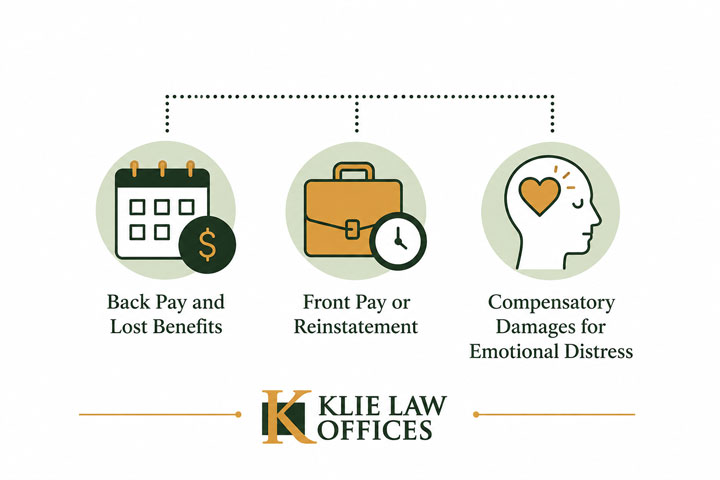
Employees who prevail in pregnancy discrimination cases may recover back pay and lost benefits, front pay or reinstatement, compensatory damages for emotional distress, punitive damages for egregious or malicious conduct, and attorney's fees and costs. West Virginia's Human Rights Act allows uncapped compensatory and punitive damages, and the PWFA provides its own remedies including compensatory damages. If the discrimination also resulted in denial of FMLA rights, additional damages may be available.
Why Choose Klie Law Offices
Pregnancy discrimination cases often involve the intersection of multiple federal and state laws — the PDA, PWFA, FMLA, ADA, and state human rights acts — each with its own requirements, protections, and remedies. At Klie Law Offices, our employment law team has extensive experience navigating this complex legal landscape and building strong cases for pregnant employees and new mothers in both West Virginia and Ohio. We fight to hold employers accountable and to recover the full damages our clients deserve.


Discriminated Against Because of Your Pregnancy?
If your employer has fired you, denied accommodations, forced you onto leave, or otherwise discriminated against you because of your pregnancy, contact Klie Law Offices for a free case evaluation, or schedule an appointment online. We serve clients from our offices in Buckhannon, Clarksburg, Morgantown, and Parkersburg in West Virginia, and Canton in Ohio.
Office Locations
Buckhannon
21 E Main St, Suite 160
Buckhannon, WV 26201
Map and Directions ↗
Parkersburg
300 Star Avenue, Unit 312
Parkersburg, WV 26101
Map and Directions ↗
Clarksburg
339 W Main St
Clarksburg, WV 26301
Map and Directions ↗
Morgantown
1300 Fort Pierpont Dr, Suite
102, Morgantown, WV 26508
Map and Directions ↗
Canton, OH
4150 Belden Village St NW
Suite 606
Canton OH, 44718
Map and Directions ↗
The first thing you’ll notice when you come to our Law Offices is that we’ll listen to your story. We want to know what you’re going through and what you need. Then, we’ll explain how West Virginia law applies to your specific situation and what your legal options are. There are no cookie-cutter answers here. We create a legal strategy tailored to each client’s individual needs.
Depending on your situation, we will find the right path forward. We are adept at resolving your legal matters through negotiation and mediation whenever possible. But we also won’t hesitate to take your case to trial if that’s what it takes to get the best possible outcome for you.
If you’re facing a legal challenge and need someone in your corner, don’t wait to get the help you deserve. Contact Klie Law Offices today to schedule a confidential consultation and take the first step toward a solution that works for you.