
FAMILY MEDICAL LEAVE ACT (FMLA)








Family and Medical Leave Act (FMLA) Rights in West Virginia and Ohio
When a serious health condition affects you or a family member, the last thing you should have to worry about is losing your job. The Family and Medical Leave Act is a federal law that gives eligible employees the right to take unpaid, job-protected leave for qualifying medical and family reasons — and it prohibits employers from retaliating against employees who exercise those rights. At Klie Law Offices, our employment law attorneys help workers throughout West Virginia and Ohio understand their FMLA rights and take legal action when employers interfere with or deny those rights.
We handle FMLA cases from our offices in Buckhannon, Clarksburg, Morgantown, Parkersburg, and Canton, Ohio.
What the FMLA Provides
The FMLA entitles eligible employees to up to 12 weeks of unpaid, job-protected leave during a 12-month period for specific qualifying reasons. During FMLA leave, the employer must maintain the employee's group health insurance coverage under the same terms as if the employee had continued working. When the employee returns from leave, they must be restored to their original position or an equivalent position with equivalent pay, benefits, and other terms of employment.
These protections are significant. Without the FMLA, at-will employees in West Virginia and Ohio could be fired simply for missing work due to a serious medical condition or family emergency. The FMLA establishes a floor of protection that applies regardless of the employer's own leave policies.

Who Is Eligible for FMLA Leave?
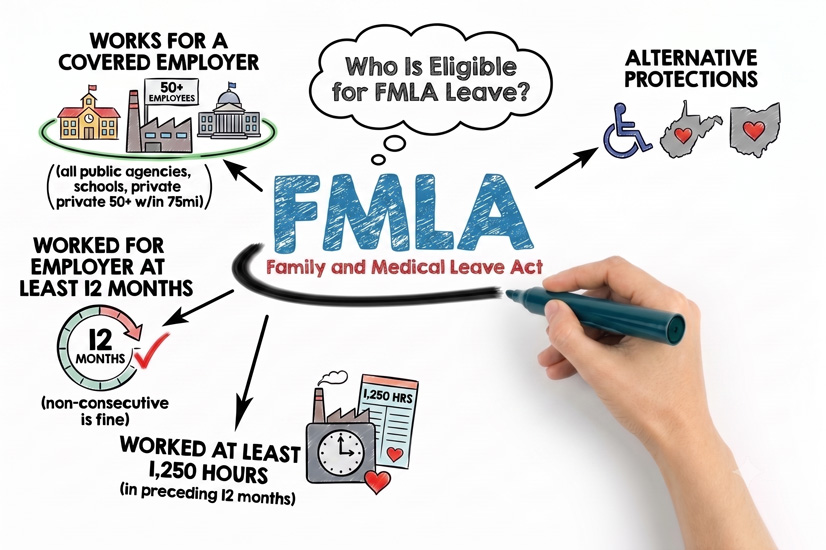
Not every employee is covered by the FMLA. To be eligible, an employee must work for a covered employer (private employers with 50 or more employees within a 75-mile radius, all public agencies, and all public and private elementary and secondary schools), have worked for the employer for at least 12 months (these months do not need to be consecutive), and have worked at least 1,250 hours during the 12-month period immediately preceding the leave.
These eligibility requirements mean that employees of small businesses, newly hired employees, and part-time employees who have not accumulated enough hours may not qualify. However, even if you are not FMLA-eligible, you may have protections under other federal or state laws, including the Americans with Disabilities Act or West Virginia's and Ohio's own leave and accommodation requirements.
Qualifying Reasons for FMLA Leave
The FMLA authorizes leave for specific, defined reasons. Understanding these categories is important because employers sometimes deny leave requests by claiming the situation does not qualify.
Your Own Serious Health Condition
You can take FMLA leave when you are unable to perform the essential functions of your job due to a serious health condition. A serious health condition includes inpatient care, conditions requiring continuing treatment by a health care provider, chronic conditions that cause periodic episodes of incapacity, pregnancy and prenatal care, and conditions requiring multiple treatments such as chemotherapy or physical therapy. Common colds, flu, earaches, and routine dental issues generally do not qualify unless complications arise.
Caring for a Family Member
You can take FMLA leave to care for a spouse, child, or parent with a serious health condition. This includes providing physical care, psychological comfort, and making arrangements for changes in care. The FMLA does not currently cover leave to care for siblings, grandparents, or in-laws, though some employers may offer broader leave policies.
Birth or Placement of a Child
Both mothers and fathers are entitled to FMLA leave for the birth of a child and to bond with the newborn, or for the placement of a child through adoption or foster care. This leave must be taken within 12 months of the birth or placement.
Military Family Leave
The FMLA provides two types of military family leave. Qualifying exigency leave allows up to 12 weeks of leave for certain needs arising from a family member's active duty or call to active duty in the armed forces. Military caregiver leave allows up to 26 weeks of leave in a single 12-month period to care for a covered servicemember with a serious injury or illness.

Client Reviews































Paid vs. Unpaid Leave
The FMLA guarantees unpaid leave. However, employers may require — or employees may choose — to substitute accrued paid leave (vacation, sick time, or PTO) for unpaid FMLA leave. When paid leave is substituted, the leave still counts against the employee's 12-week FMLA entitlement. West Virginia's Parental Leave Act provides additional protections for certain state employees.
How FMLA Leave Works
Notice Requirements
When the need for leave is foreseeable — such as a scheduled surgery or the expected birth of a child — the employee must provide 30 days' advance notice. When the need for leave is not foreseeable — such as a sudden medical emergency — the employee must provide notice as soon as practicable, which generally means within one or two business days. The employee does not need to specifically mention the FMLA, but they must provide enough information for the employer to determine whether the leave may qualify.
Medical Certification
The employer may require a medical certification from a health care provider to support the leave request. The certification must confirm the existence of a serious health condition and provide information about the expected duration and nature of the condition. The employer may request recertification under certain circumstances but cannot contact the employee's health care provider directly — they must use a designated HR representative or other company official for that communication.
Intermittent Leave
FMLA leave does not have to be taken all at once. When medically necessary, employees can take leave intermittently — in separate blocks of time — or on a reduced schedule. For example, an employee undergoing chemotherapy might take one day off per week for treatment. Intermittent leave can be particularly valuable for chronic conditions that require periodic medical appointments or cause unpredictable flare-ups.
FMLA Violations by Employers
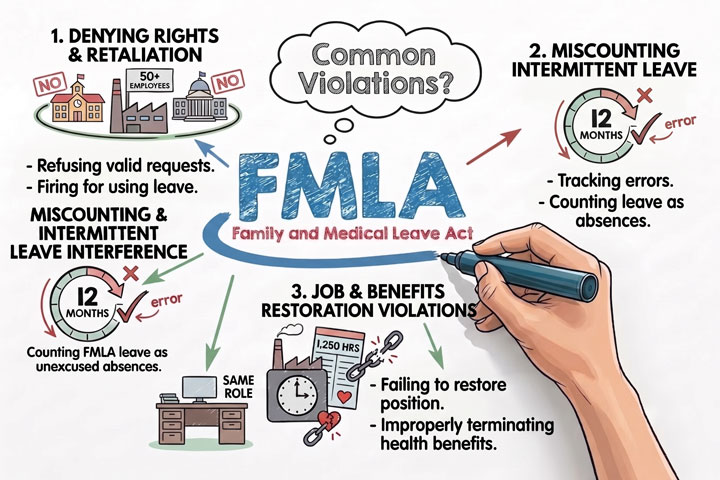
Employer violations of the FMLA are disturbingly common. Some of the most frequent violations include denying FMLA leave to eligible employees for qualifying reasons, firing or disciplining employees for taking FMLA leave, counting FMLA absences against employees under attendance policies, failing to restore the employee to their position (or an equivalent position) upon return from leave, retaliating against employees who request or take FMLA leave, failing to maintain health insurance during FMLA leave, discouraging employees from requesting FMLA leave, and requiring employees to find their own replacements as a condition of taking leave.
These violations can take two legal forms: interference (where the employer prevents the employee from exercising their FMLA rights) and retaliation (where the employer punishes the employee for exercising those rights). Both are illegal and both can result in significant liability for the employer.
Damages for FMLA Violations
Employees who prevail in FMLA claims may recover lost wages and benefits, compensation for out-of-pocket expenses caused by the violation, liquidated damages equal to the amount of lost wages (effectively doubling the monetary recovery), reinstatement to the former position or front pay in lieu of reinstatement, and attorney's fees and costs. The availability of liquidated damages makes FMLA claims particularly consequential for employers who violate the law.
Helpful Shorts From Our TikTok
Klie Law Office F.A.Q
1. What should I do immediately after a personal injury accident?
After a personal injury accident, your safety comes first. Seek medical attention right away, even if you feel fine, as some injuries may not be immediately apparent. If possible, document the scene by taking photos, gathering witness information, and filing an accident report. Then, contact an experienced personal injury attorney at Klie Law Offices to discuss your rights and next steps.
2. How do I know if I have a valid personal injury claim?
If you were injured because of someone else’s negligence or reckless actions, you may have a valid personal injury claim. Common situations include car accidents, slip and falls, workplace injuries, and dog bites. Our attorneys offer free consultations to review your situation and determine whether you have a case.
3. How much is my personal injury case worth?
The value of a personal injury case depends on several factors, including the severity of your injuries, medical expenses, lost wages, pain and suffering, and long-term impacts on your life. Every case is unique, so we carefully evaluate the details to pursue the maximum compensation available under the law.
4. Will my personal injury case go to court?
Most personal injury cases are settled outside of court through negotiations with insurance companies or at mediation. However, if a fair settlement cannot be reached, Klie Law Offices is prepared to represent you in court and fight for the compensation you deserve.
5. How much does it cost to hire a personal injury lawyer at Klie Law Offices?
Klie Law Offices handles personal injury cases on a contingency fee basis. This means you pay no upfront costs, and we only get paid if we recover compensation for you. Your initial consultation is free, and we’ll explain all fees and terms clearly before you decide to move forward.

Civil Litigation Team
Civil Litigation Attorneys








Administrative Assistant

Civil Litigation Paralegals



Civil Litigation Practice Coordinator

Civil Litigation Law Clerk


FMLA and Other Leave Laws
The FMLA does not exist in isolation. It often intersects with other leave and accommodation laws, including the Americans with Disabilities Act, which may require additional unpaid leave as a reasonable accommodation beyond the 12 weeks provided by the FMLA. Workers' compensation leave may run concurrently with FMLA leave in some circumstances. And state-specific laws may provide additional protections. Navigating the interaction between these overlapping laws requires experienced legal guidance.
Why Choose Klie Law Offices
FMLA cases require attorneys who understand both the statute's technical requirements and the practical ways employers try to circumvent them. At Klie Law Offices, our employment law team has extensive experience handling FMLA interference and retaliation claims in West Virginia and Ohio. We help employees understand their rights, document violations, file timely claims, and recover the full damages available under the law.

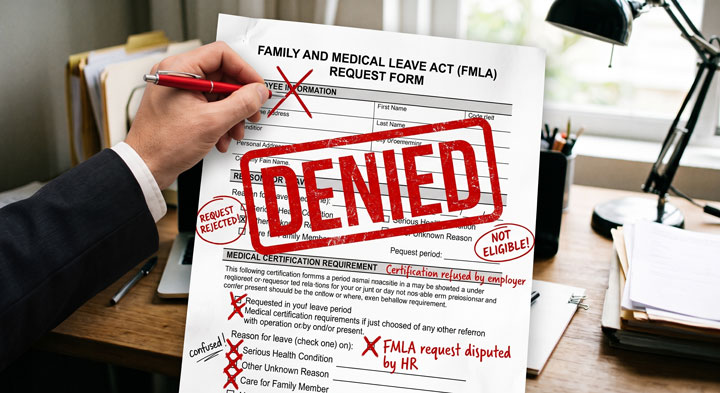
Was Your FMLA Leave Denied or Punished?
If your employer denied your leave request, fired you for taking leave, or retaliated against you in any way for exercising your FMLA rights, you may have a legal claim. Contact Klie Law Offices for a free case evaluation, or schedule an appointment online. We serve clients from our offices in Buckhannon, Clarksburg, Morgantown, and Parkersburg in West Virginia, and Canton in Ohio.
Office Locations
Buckhannon
21 E Main St, Suite 160
Buckhannon, WV 26201
Map and Directions ↗
Parkersburg
300 Star Avenue, Unit 312
Parkersburg, WV 26101
Map and Directions ↗
Clarksburg
339 W Main St
Clarksburg, WV 26301
Map and Directions ↗
Morgantown
1300 Fort Pierpont Dr, Suite
102, Morgantown, WV 26508
Map and Directions ↗
Canton, OH
4150 Belden Village St NW
Suite 606
Canton OH, 44718
Map and Directions ↗
The first thing you’ll notice when you come to our Law Offices is that we’ll listen to your story. We want to know what you’re going through and what you need. Then, we’ll explain how West Virginia law applies to your specific situation and what your legal options are. There are no cookie-cutter answers here. We create a legal strategy tailored to each client’s individual needs.
Depending on your situation, we will find the right path forward. We are adept at resolving your legal matters through negotiation and mediation whenever possible. But we also won’t hesitate to take your case to trial if that’s what it takes to get the best possible outcome for you.
If you’re facing a legal challenge and need someone in your corner, don’t wait to get the help you deserve. Contact Klie Law Offices today to schedule a confidential consultation and take the first step toward a solution that works for you.