
Wrongful Termination









Wrongful Termination in West Virginia and Ohio
Losing your job is stressful under any circumstances. But when you are fired for an illegal reason — because you reported discrimination, refused to break the law, exercised a legal right, or belong to a protected class — the law gives you the right to fight back. Both West Virginia and Ohio are at-will employment states, but at-will does not mean your employer can fire you for any reason. There are important legal boundaries, and crossing them gives rise to a wrongful termination claim. At Klie Law Offices, our employment law attorneys represent workers throughout West Virginia and Ohio who have been illegally fired and help them hold their employers accountable.
We handle wrongful termination cases from our offices in Buckhannon, Clarksburg, Morgantown, Parkersburg, and Canton, Ohio.
What Is Wrongful Termination?
Wrongful termination — also called wrongful discharge — occurs when an employer fires an employee in violation of federal or state law, public policy, or an employment contract. It is not enough for a termination to be unfair, unreasonable, or based on bad judgment. To be legally actionable, the termination must violate a specific legal prohibition. However, the range of legal prohibitions is broader than most employees realize, and many terminations that employers try to pass off as legitimate at-will decisions are, in fact, illegal.

Common Grounds for Wrongful Termination Claims
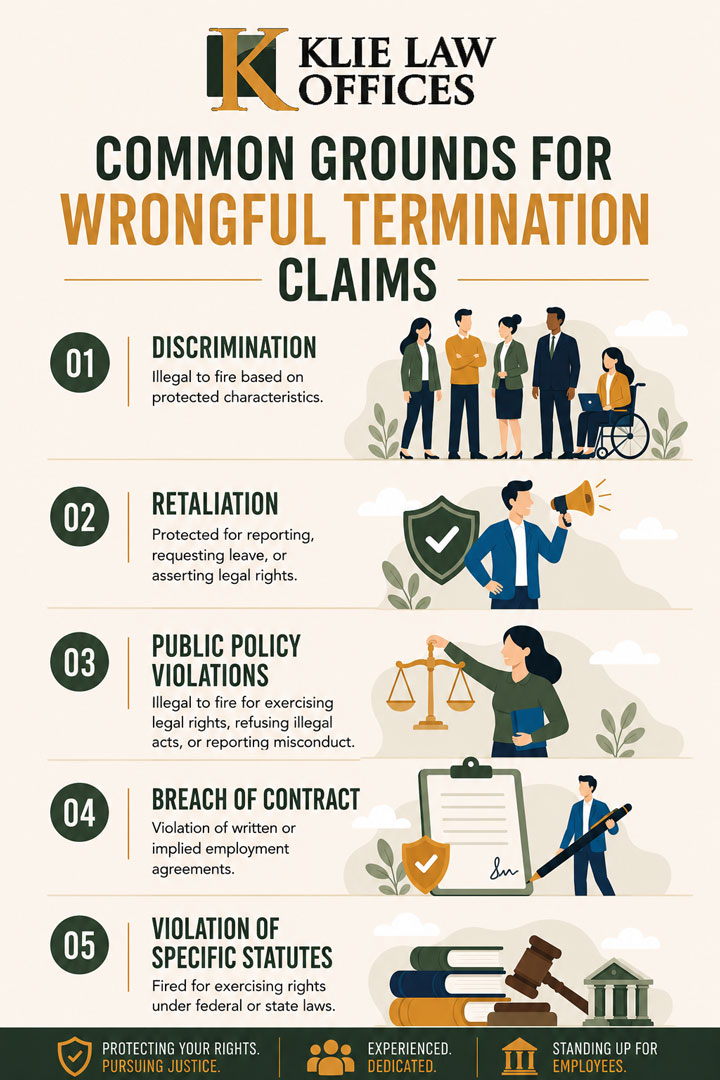
Discrimination
It is illegal to fire an employee because of their race, color, national origin, sex, religion, age (40 or older), disability, pregnancy, genetic information, or other protected characteristics. Workplace discrimination claims can be brought under Title VII of the Civil Rights Act, the Age Discrimination in Employment Act, the Americans with Disabilities Act, the West Virginia Human Rights Act, or Ohio Revised Code Chapter 4112. Employers often do not announce discriminatory motivations — instead, they offer pretextual reasons that crumble under scrutiny.
Retaliation
Employer retaliation is one of the most common bases for wrongful termination claims. Employers cannot fire employees for reporting discrimination or sexual harassment, filing wage complaints or asserting overtime rights, requesting or taking FMLA leave, filing workers' compensation claims, reporting safety violations to OSHA, whistleblowing on illegal employer conduct, participating in workplace investigations, or cooperating with government inquiries. The law protects the act of engaging in these protected activities, and firing someone for doing so is independently illegal regardless of whatever other reasons the employer may offer.
Public Policy Violations
West Virginia has one of the strongest public policy exceptions to at-will employment in the country. Under this doctrine, an employer cannot fire an employee for reasons that violate a clear and established public policy. This includes firing an employee for refusing to commit an illegal act at the employer's direction, exercising a statutory right such as voting, serving on a jury, or filing a legal claim, performing a public duty or obligation, and reporting illegal conduct by the employer. West Virginia courts have applied the public policy exception broadly to protect employees from retaliatory and bad-faith terminations. Ohio recognizes a similar public policy tort, though it has been interpreted somewhat more narrowly.
Breach of Contract
If you have a written employment contract that limits the employer's right to terminate you — for example, a contract that states you can only be fired for cause, or that requires specific procedures before termination — firing you in violation of that contract is wrongful termination. Even without a formal written contract, an implied contract may arise from the employer's handbook, policies, or verbal assurances. If the employee handbook states that employees will not be terminated without progressive discipline, for instance, that language may create an implied contractual obligation that the employer must follow. If your employer broke the terms of a written or implied agreement, learn more about employment contract violations.
Violation of Specific Statutes
Numerous federal and state statutes contain anti-termination provisions. You cannot be fired for taking military leave under USERRA, asserting your rights under the Fair Labor Standards Act, reporting environmental violations, exercising rights under the National Labor Relations Act, or refusing to take a polygraph test in violation of the Employee Polygraph Protection Act, among many others. Each statute provides its own remedies, and some provide for enhanced damages. West Virginia’s own statutes go further: the West Virginia Human Rights Act protects employees against human rights violations at work, and the Wage Payment and Collection Act sets strict deadlines for your final paycheck after termination.

Constructive Discharge
Not all wrongful terminations involve the employer directly firing the employee. Constructive discharge occurs when the employer makes working conditions so intolerable that a reasonable person would feel compelled to resign. If an employer subjects an employee to severe harassment, strips them of responsibilities, imposes impossible demands, cuts their pay or hours dramatically, or otherwise makes the job unbearable in response to the employee's protected activity, the resulting resignation is treated as a termination for legal purposes. Constructive discharge claims require showing that the conditions were truly intolerable and that the employer either intended to force the resignation or was deliberately indifferent to the conditions.
Proving Wrongful Termination
Employers rarely admit that they fired someone for an illegal reason. Instead, they offer alternative explanations — poor performance, downsizing, restructuring, misconduct, or violation of company policy. The employee's task is to show that the employer's stated reason is pretextual and that the real motivation was illegal.
Evidence that can help establish wrongful termination includes the timing between a protected activity and the termination, inconsistencies between the stated reason and the employee's actual work record, evidence that other employees who engaged in similar conduct were not fired, sudden negative performance reviews after years of positive evaluations, statements by supervisors or managers that reveal discriminatory or retaliatory intent, statistical evidence of patterns in hiring, firing, or promotion, the employer's failure to follow its own progressive discipline procedures, and evidence that the employer's explanation changed over time.
Client Reviews






























Damages in Wrongful Termination Cases
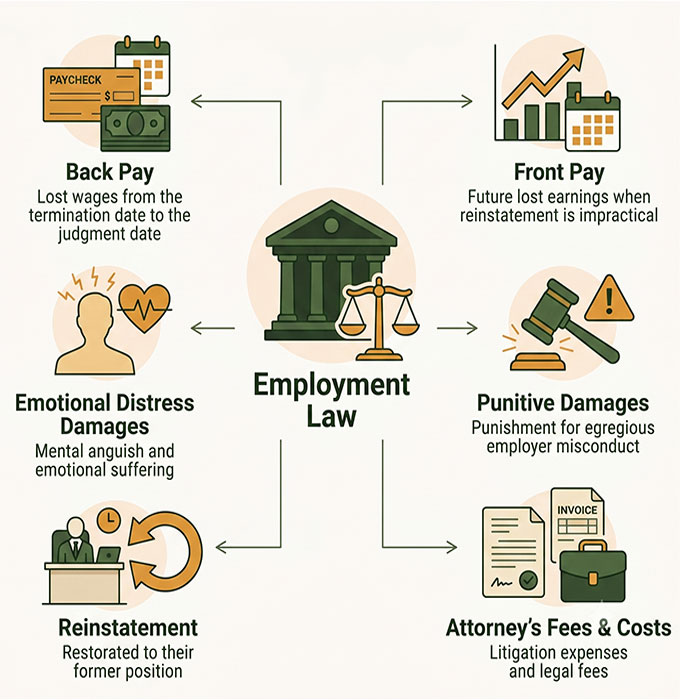
The remedies available in wrongful termination cases depend on the legal theory under which the claim is brought, but may include back pay from the date of termination to the date of judgment, front pay for future lost earnings when reinstatement is not practical, compensatory damages for emotional distress and mental anguish, punitive damages designed to punish particularly egregious employer conduct, reinstatement to the former position, and attorney's fees and litigation costs. West Virginia's public policy tort and the West Virginia Human Rights Act both allow for significant compensatory and punitive damage awards. Federal claims under Title VII, the ADA, and the ADEA have their own damage frameworks, with some subject to statutory caps.
If your employer fails to act on your complaint, you have the right to file a charge with the Equal Employment Opportunity Commission, the West Virginia Human Rights Commission, or the Ohio Civil Rights Commission. These agencies investigate harassment complaints and can pursue enforcement action against the employer. Filing an agency charge is also typically a prerequisite to filing a private lawsuit under Title VII.
Helpful Shorts From Our TikTok
Klie Law Office F.A.Q
1. What should I do immediately after a personal injury accident?
After a personal injury accident, your safety comes first. Seek medical attention right away, even if you feel fine, as some injuries may not be immediately apparent. If possible, document the scene by taking photos, gathering witness information, and filing an accident report. Then, contact an experienced personal injury attorney at Klie Law Offices to discuss your rights and next steps.
2. How do I know if I have a valid personal injury claim?
If you were injured because of someone else’s negligence or reckless actions, you may have a valid personal injury claim. Common situations include car accidents, slip and falls, workplace injuries, and dog bites. Our attorneys offer free consultations to review your situation and determine whether you have a case.
3. How much is my personal injury case worth?
The value of a personal injury case depends on several factors, including the severity of your injuries, medical expenses, lost wages, pain and suffering, and long-term impacts on your life. Every case is unique, so we carefully evaluate the details to pursue the maximum compensation available under the law.
4. Will my personal injury case go to court?
Most personal injury cases are settled outside of court through negotiations with insurance companies or at mediation. However, if a fair settlement cannot be reached, Klie Law Offices is prepared to represent you in court and fight for the compensation you deserve.
5. How much does it cost to hire a personal injury lawyer at Klie Law Offices?
Klie Law Offices handles personal injury cases on a contingency fee basis. This means you pay no upfront costs, and we only get paid if we recover compensation for you. Your initial consultation is free, and we’ll explain all fees and terms clearly before you decide to move forward.

Civil Litigation Team
Civil Litigation Attorneys








Administrative Assistant

Civil Litigation Paralegals



Civil Litigation Practice Coordinator

Civil Litigation Law Clerk

Filing Deadlines
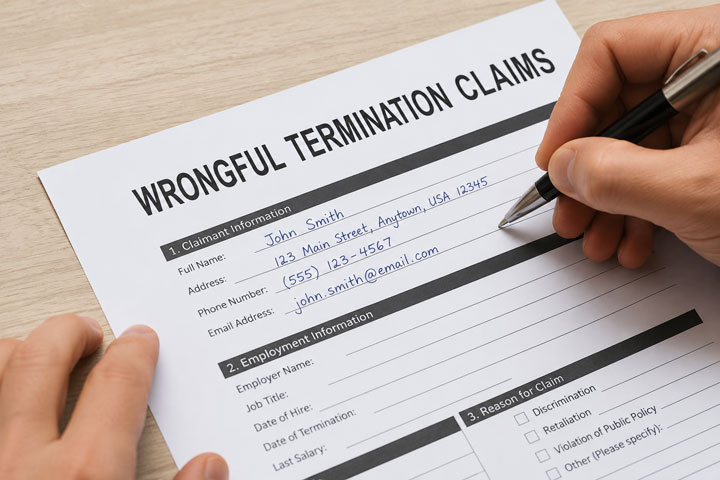
Wrongful termination claims are subject to strict filing deadlines that vary depending on the legal theory. Title VII and ADA claims require filing an EEOC charge within 300 days of the termination in states with a fair employment practices agency (both West Virginia and Ohio qualify). The West Virginia Human Rights Act has a 365-day filing deadline. Ohio Revised Code Chapter 4112 claims must be filed within the applicable statute of limitations. Public policy tort claims are subject to the general personal injury statute of limitations. Missing these deadlines can permanently bar your claim, which is why consulting with an attorney promptly after termination is critical.
Why Choose Klie Law Offices
Wrongful termination cases are often complex, involving multiple potential legal theories, overlapping filing deadlines, and employers who will aggressively defend their decisions. At Klie Law Offices, our employment law team has extensive experience identifying and pursuing wrongful termination claims under every available theory in both West Virginia and Ohio. We investigate the circumstances of each termination, expose pretextual justifications, and fight to recover the maximum damages our clients are entitled to. For more information about how an attorney can help with your wrongful termination claim, see our page on how a lawyer can help.


Were You Illegally Fired?
If you believe you were terminated for an illegal reason, time is not on your side — strict filing deadlines apply to most wrongful termination claims. Contact Klie Law Offices for a free case evaluation, or schedule an appointment online. We serve clients from our offices in Buckhannon, Clarksburg, Morgantown, and Parkersburg in West Virginia, and Canton in Ohio.
Office Locations
Buckhannon
21 E Main St, Suite 160
Buckhannon, WV 26201
Map and Directions ↗
Parkersburg
300 Star Avenue, Unit 312
Parkersburg, WV 26101
Map and Directions ↗
Clarksburg
339 W Main St
Clarksburg, WV 26301
Map and Directions ↗
Morgantown
1300 Fort Pierpont Dr, Suite
102, Morgantown, WV 26508
Map and Directions ↗
Canton, OH
4150 Belden Village St NW
Suite 606
Canton OH, 44718
Map and Directions ↗
The first thing you’ll notice when you come to our Law Offices is that we’ll listen to your story. We want to know what you’re going through and what you need. Then, we’ll explain how West Virginia law applies to your specific situation and what your legal options are. There are no cookie-cutter answers here. We create a legal strategy tailored to each client’s individual needs.
Depending on your situation, we will find the right path forward. We are adept at resolving your legal matters through negotiation and mediation whenever possible. But we also won’t hesitate to take your case to trial if that’s what it takes to get the best possible outcome for you.
If you’re facing a legal challenge and need someone in your corner, don’t wait to get the help you deserve. Contact Klie Law Offices today to schedule a confidential consultation and take the first step toward a solution that works for you.