
DISABILITY DISCRIMINATION









Disability Discrimination in the Workplace: West Virginia and Ohio
If you have a disability, your employer is required by law to evaluate you based on what you can do — not to make assumptions about what you cannot. Federal and state laws prohibit employers from discriminating against qualified individuals with disabilities and require employers to provide reasonable accommodations that allow disabled employees to perform their jobs. When employers violate these obligations — by refusing accommodations, firing employees because of a disability, or creating a hostile work environment — they must be held accountable. At Klie Law Offices, our employment law attorneys represent workers with disabilities throughout West Virginia and Ohio and fight to protect their right to equal treatment in the workplace.
We handle disability discrimination cases from our offices in Buckhannon, Clarksburg, Morgantown, Parkersburg, and Canton, Ohio.
Laws Protecting Workers with Disabilities
The Americans with Disabilities Act
The ADA is the primary federal law prohibiting disability discrimination in employment. Title I of the ADA applies to employers with 15 or more employees and prohibits discrimination against qualified individuals with disabilities in all aspects of employment — hiring, firing, pay, promotions, job assignments, training, benefits, and any other term or condition of employment. The ADA also requires employers to provide reasonable accommodations to qualified employees and applicants with disabilities unless doing so would impose an undue hardship on the employer's operations.
The ADA Amendments Act of 2008 significantly broadened the definition of disability, making it easier for employees to establish that they are covered by the law. Under the current standard, a disability is a physical or mental impairment that substantially limits one or more major life activities. Major life activities include walking, seeing, hearing, speaking, breathing, learning, concentrating, thinking, communicating, sleeping, eating, lifting, bending, reading, and working, among others. The amended definition is intended to be interpreted broadly, and courts have recognized a wide range of conditions as disabilities including diabetes, epilepsy, cancer, PTSD, depression, anxiety disorders, multiple sclerosis, heart conditions, back injuries, and many other
West Virginia Human Rights Act
West Virginia's Human Rights Act prohibits disability discrimination by employers with 12 or more employees. The Act's definition of disability is broadly interpreted, and West Virginia courts have applied it to cover a wide range of physical and mental conditions. Importantly, the West Virginia Human Rights Act does not cap compensatory or punitive damages, making it a particularly powerful tool for disability discrimination claims. The Act also protects employees who are perceived as having a disability, even if they do not actually have one — addressing situations where an employer takes adverse action based on stereotypes or assumptions about a condition.
Ohio Revised Code Chapter 4112
Ohio's anti-discrimination statute prohibits disability discrimination and applies to employers with four or more employees, providing broader coverage than the federal ADA. Ohio law defines disability as a physical or mental impairment that substantially limits one or more major life activities and requires employers to provide reasonable accommodations. Our Canton office attorneys are experienced in pursuing disability discrimination claims under Ohio's specific statutory framework.
Reasonable Accommodations
The duty to provide reasonable accommodations is one of the most important — and most frequently violated — aspects of disability discrimination law. A reasonable accommodation is a modification or adjustment to a job, the work environment, or the way things are usually done that enables a qualified individual with a disability to perform the essential functions of the position.

Examples of Reasonable Accommodations
Common reasonable accommodations include modified work schedules or flexible scheduling, reassignment to a vacant position, physical modifications to the workspace such as accessible workstations, ergonomic equipment, or ramps, assistive technology including screen readers, speech recognition software, or amplified phones, additional unpaid leave beyond what FMLA or company policy provides, permission to work from home or telecommute, modified break schedules for medication or medical needs, job restructuring to reallocate non-essential functions, and temporary light duty assignments.
The Interactive Process
When an employee requests an accommodation or the employer becomes aware that an accommodation may be needed, the employer is required to engage in an interactive process — a good-faith dialogue between the employer and employee to identify the employee's limitations, discuss potential accommodations, and determine an effective accommodation that allows the employee to perform the essential functions of the job. Employers who refuse to engage in the interactive process, or who go through the motions without genuinely considering accommodations, violate their obligations under the ADA.
Undue Hardship
An employer is not required to provide an accommodation that would impose an undue hardship — a significant difficulty or expense relative to the employer's size, financial resources, and the nature and structure of its operations. However, the undue hardship defense is narrowly applied, and courts evaluate it based on the specific employer's circumstances. What constitutes undue hardship for a small business may not qualify for a large corporation. Employers cannot simply claim that an accommodation is too expensive or inconvenient — they must demonstrate with specific evidence that the accommodation would cause genuine hardship.
Common Forms of Disability Discrimination
Failure to Accommodate
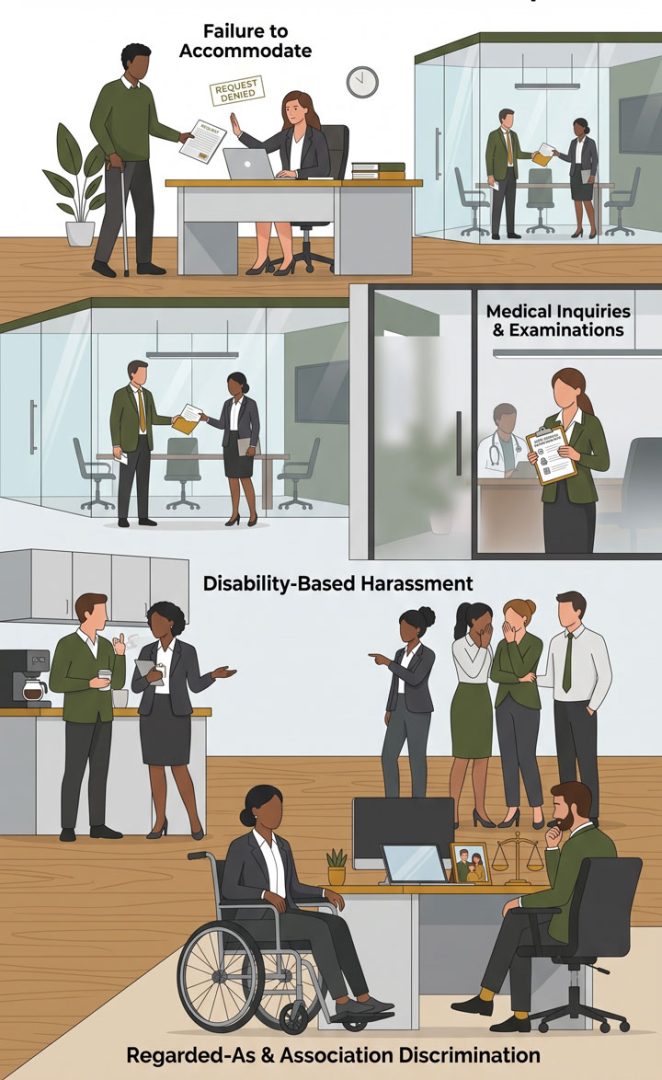
The most common disability discrimination claims involve an employer's refusal to provide reasonable accommodations. This includes outright denying accommodation requests, ignoring requests and hoping the employee gives up, providing ineffective accommodations that do not actually address the limitation, and refusing to engage in the interactive process at all. If you requested an accommodation and your employer denied it without exploring alternatives or demonstrating undue hardship, you may have a failure-to-accommodate claim.
Adverse Employment Actions
Employers who fire, demote, refuse to hire, deny promotions to, or otherwise disadvantage employees because of a disability are engaging in illegal discrimination. This includes situations where the employer takes action based on stereotypes or assumptions about the disability — for example, assuming that an employee with epilepsy cannot work safely, without conducting an individualized assessment of the employee's actual abilities and limitations.
Medical Inquiries and Examinations
The ADA strictly limits when and how employers can make disability-related inquiries or require medical examinations. Before making a job offer, the employer generally cannot ask about disabilities or require medical exams. After a conditional job offer, the employer can require a medical examination only if it requires the same examination of all entering employees in that job category. During employment, disability-related inquiries and medical exams are permitted only when they are job-related and consistent with business necessity.
Harassment Based on Disability
Persistent comments, jokes, or negative remarks about an employee's disability can create a hostile work environment. When disability-based harassment is severe or pervasive enough to alter the employee's working conditions, it constitutes illegal discrimination. This includes mocking an employee's physical limitations, mimicking speech patterns associated with a disability, or making comments suggesting that the employee is a burden.
Regarded-As and Association Discrimination
The ADA also protects individuals who are regarded as having a disability even if they do not actually have one. If an employer takes adverse action against an employee based on the belief — even a mistaken belief — that the employee has a disability, that action is discriminatory. Additionally, the ADA prohibits discrimination against employees because of their association with a person who has a disability, such as a family member with a chronic illness.
Client Reviews






























Disability Discrimination and Other Claims
Disability discrimination cases frequently overlap with other employment law claims. Retaliation claims arise when the employer punishes the employee for requesting accommodations or filing a discrimination complaint. FMLA claims arise when the employee's disability also constitutes a serious health condition entitling them to job-protected leave. Workers' compensation retaliation claims arise when the disability resulted from a workplace injury. And wrongful termination claims arise when the employee is fired because of their disability. An experienced attorney can identify and pursue all available theories to maximize recovery.
Damages in Disability Discrimination Cases
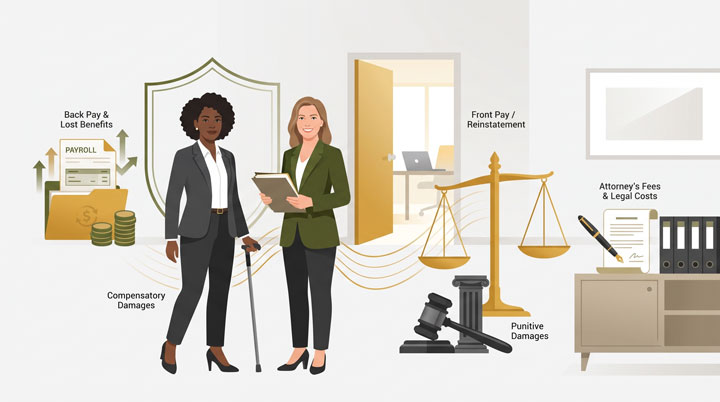
Employees who prevail in disability discrimination cases may recover back pay and lost benefits, front pay or reinstatement, compensatory damages for emotional distress and out-of-pocket expenses, punitive damages in cases of egregious or malicious conduct, and attorney's fees and costs. Under the ADA, compensatory and punitive damages are subject to statutory caps that vary based on employer size, but the West Virginia Human Rights Act imposes no such caps, and Ohio law provides its own damage remedies. Pursuing claims under both federal and state law allows the attorney to seek the maximum available recovery.
Helpful Shorts From Our TikTok
Klie Law Office F.A.Q
1. What should I do immediately after a personal injury accident?
After a personal injury accident, your safety comes first. Seek medical attention right away, even if you feel fine, as some injuries may not be immediately apparent. If possible, document the scene by taking photos, gathering witness information, and filing an accident report. Then, contact an experienced personal injury attorney at Klie Law Offices to discuss your rights and next steps.
2. How do I know if I have a valid personal injury claim?
If you were injured because of someone else’s negligence or reckless actions, you may have a valid personal injury claim. Common situations include car accidents, slip and falls, workplace injuries, and dog bites. Our attorneys offer free consultations to review your situation and determine whether you have a case.
3. How much is my personal injury case worth?
The value of a personal injury case depends on several factors, including the severity of your injuries, medical expenses, lost wages, pain and suffering, and long-term impacts on your life. Every case is unique, so we carefully evaluate the details to pursue the maximum compensation available under the law.
4. Will my personal injury case go to court?
Most personal injury cases are settled outside of court through negotiations with insurance companies or at mediation. However, if a fair settlement cannot be reached, Klie Law Offices is prepared to represent you in court and fight for the compensation you deserve.
5. How much does it cost to hire a personal injury lawyer at Klie Law Offices?
Klie Law Offices handles personal injury cases on a contingency fee basis. This means you pay no upfront costs, and we only get paid if we recover compensation for you. Your initial consultation is free, and we’ll explain all fees and terms clearly before you decide to move forward.

Civil Litigation Team
Civil Litigation Attorneys








Administrative Assistant

Civil Litigation Paralegals



Civil Litigation Practice Coordinator

Civil Litigation Law Clerk

Why Choose Klie Law Offices
Disability discrimination cases require attorneys who understand the technical requirements of the ADA, the interactive accommodation process, and the ways employers attempt to circumvent their obligations. At Klie Law Offices, our employment law team has extensive experience representing employees with disabilities in West Virginia and Ohio. We evaluate accommodation requests, challenge pretextual denials, and pursue the full range of damages available under federal and state law.


Facing Disability Discrimination at Work?
If your employer has denied reasonable accommodations, fired you because of a disability, or subjected you to a hostile work environment, contact Klie Law Offices for a free case evaluation, or schedule an appointment online. We serve clients from our offices in Buckhannon, Clarksburg, Morgantown, and Parkersburg in West Virginia, and Canton in Ohio.
Office Locations
Buckhannon
21 E Main St, Suite 160
Buckhannon, WV 26201
Map and Directions ↗
Parkersburg
300 Star Avenue, Unit 312
Parkersburg, WV 26101
Map and Directions ↗
Clarksburg
339 W Main St
Clarksburg, WV 26301
Map and Directions ↗
Morgantown
1300 Fort Pierpont Dr, Suite
102, Morgantown, WV 26508
Map and Directions ↗
Canton, OH
4150 Belden Village St NW
Suite 606
Canton OH, 44718
Map and Directions ↗
The first thing you’ll notice when you come to our Law Offices is that we’ll listen to your story. We want to know what you’re going through and what you need. Then, we’ll explain how West Virginia law applies to your specific situation and what your legal options are. There are no cookie-cutter answers here. We create a legal strategy tailored to each client’s individual needs.
Depending on your situation, we will find the right path forward. We are adept at resolving your legal matters through negotiation and mediation whenever possible. But we also won’t hesitate to take your case to trial if that’s what it takes to get the best possible outcome for you.
If you’re facing a legal challenge and need someone in your corner, don’t wait to get the help you deserve. Contact Klie Law Offices today to schedule a confidential consultation and take the first step toward a solution that works for you.