
PUBLIC EMPLOYEE GRIEVANCES









Public Employee Grievances in West Virginia and Ohio
Public employees — those who work for state, county, municipal, and other government entities — have workplace protections that go beyond what is available to most private sector workers. When a public employer violates those protections through unfair discipline, wrongful termination, denial of benefits, unsafe working conditions, or other adverse actions, the grievance process provides a formal mechanism to challenge the employer's decision and seek a remedy. At Klie Law Offices, our employment law attorneys represent public employees throughout West Virginia and Ohio in grievance proceedings and related employment disputes. We understand the unique rules, procedures, and timelines that apply to government workers, and we fight to protect their careers and their rights.
We handle public employee grievance cases from our offices in Buckhannon, Clarksburg, Morgantown, Parkersburg, and Canton, Ohio.
What Is a Public Employee Grievance?
A grievance is a formal complaint filed by a public employee alleging that the employer has violated the employee's rights under applicable statutes, regulations, policies, or collective bargaining agreements. The grievance process is an administrative procedure — separate from filing a lawsuit — that provides public employees with a structured path to challenge adverse employment actions and seek corrective relief. Grievances can address a wide range of workplace issues, and the process typically involves multiple levels of review, culminating in a hearing before an independent decision-maker if the dispute is not resolved at earlier stages.

West Virginia Public Employee Grievance Process
West Virginia's public employee grievance system is governed by the West Virginia Public Employees Grievance Procedure, which provides a detailed, multi-step process for resolving workplace disputes involving state, county, and municipal employees.
Who Is Covered
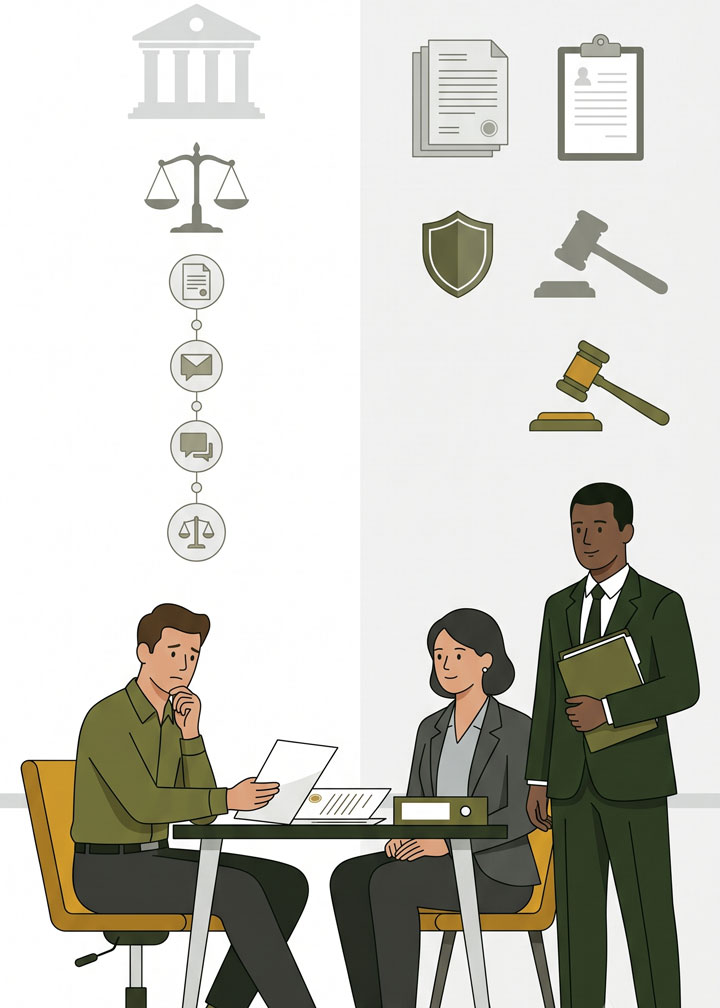
The West Virginia grievance process covers employees of the state and its political subdivisions, including state agency employees, county employees, municipal employees, public school employees (including teachers and support staff), higher education employees, and employees of other public entities. Both classified and non-classified employees may have access to the grievance process, though the specific protections available can vary based on the employee's classification and the nature of the dispute.
Grounds for Filing a Grievance
West Virginia public employees can file grievances over a broad range of workplace issues. Common grounds include disciplinary actions such as suspension, demotion, or termination, wrongful termination or discharge without just cause, discrimination based on race, sex, age, disability, religion, national origin, or other protected characteristics, retaliation for whistleblowing, filing complaints, or engaging in other protected activities, sexual harassment or hostile work environment, violations of leave policies including sick leave, annual leave, and FMLA rights, unfair application of workplace policies or rules, denial of promotion or transfer based on improper criteria, wage and compensation disputes, unsafe working conditions, and violations of collective bargaining agreements.
The Grievance Process Steps
West Virginia's grievance procedure typically involves multiple levels. The process begins when the employee files a written grievance within the applicable time frame — typically within a set number of days after the event giving rise to the grievance. Strict adherence to these deadlines is critical, as failure to file on time can result in the grievance being dismissed regardless of its merits.
At the first level, the grievance is reviewed by the employee's immediate supervisor or a designated administrator, who issues a written decision. If the employee is not satisfied with the first-level decision, they can appeal to the next level — typically a higher-level administrator or department head. If the dispute remains unresolved after the initial levels of review, the employee can request a hearing before the West Virginia Public Employees Grievance Board. The Grievance Board hearing is a formal proceeding where both sides present evidence and testimony, and an administrative law judge issues a binding decision.
Grievance Board Hearings
The Grievance Board hearing is the most critical stage of the process. It functions similarly to a trial — the employee and the employer each present witnesses, introduce documents, and make legal arguments. The administrative law judge evaluates the evidence, applies the relevant legal standards, and issues a written decision that can include reinstatement, back pay, restoration of benefits, reversal of disciplinary action, and other appropriate remedies. Having experienced legal representation at the Grievance Board hearing is essential because the procedural rules, evidentiary standards, and burden of proof requirements can be complex, and the outcome is binding.
Appeals
Grievance Board decisions can be appealed to circuit court, and from there to the West Virginia Supreme Court of Appeals. The standard of review on appeal is deferential to the Grievance Board's factual findings, which means that building a strong evidentiary record at the hearing level is critically important — the appellate courts will generally not second-guess the administrative law judge's credibility determinations or factual conclusions.
Ohio Public Employee Protections
Ohio public employees are protected by a combination of civil service statutes, collective bargaining agreements, and constitutional due process rights. Ohio's classified civil service system provides that classified employees can only be removed, suspended, or reduced in pay for cause, and they are entitled to a pre-disciplinary hearing and the right to appeal to the State Personnel Board of Review. Ohio public employees who are covered by collective bargaining agreements have additional protections through the grievance and arbitration procedures negotiated in those agreements.
Ohio's public employee collective bargaining law — the State Employment Relations Act — governs the relationship between public employers and employee unions, and provides a framework for resolving disputes over contract interpretation, disciplinary actions, and working conditions. Our Canton office attorneys are experienced in representing Ohio public employees through both civil service proceedings and collective bargaining grievance processes.
Client Reviews










Day one, I was treated very nicely and worn respect . My attorney, Ally was absolutely amazing and I am so thankful she was my attorney . Ally kept me informed, and always had my best interest at heart. I would absolutely recommend her.
. She had my back the whole time during my divorce process and fought for me all the way through. She made the divorce process so smooth and easy for me . I would recommend Klie Law, 100%, to anyone looking for great representation during the very stressful time of going through a divorce . I am reallly really appreciative of everything that was done for me. Don't have words to tell you how much I love this firm!!! Happy Holidays!!


When I first started, I had no idea where to begin, what steps to take, or who to turn to. Thankfully, I found Alysson Fleenor, Ethan Herrick, and the rest of the legal team at Klie Law, and I couldn't have asked for better guidance.
They were not only professional and efficient but also incredibly patient and communicative every step of the way. They made sure everything moved smoothly and without unnecessary delays or complications. Honestly, I was surprised at how quickly things progressed, but that’s a testament to how well they handled my case.
The team truly took care of me, and I felt supported the entire time. I would absolutely recommend Klie Law to anyone in need of legal representation, especially if you’re looking for a team that offers clear communication, genuine care, and a steady hand to help you through such a life-changing transition. Even if you just need help finding direction during a difficult time, Klie Law is where I’d send you.


Thanks to her efforts, the case was resolved in my favor, far exceeding my expectations. I felt supported, respected, and confident throughout the entire process.
If you’re looking for a lawyer who combines intellect, integrity, and heart, look no further. I wholeheartedly recommend Kimberly Koslski to anyone in need of outstanding legal representation.





Gabby is very knowledgeable and will fight for what you want in the courtroom!
Jennifer and Katie are always quick to respond to any question or concern you may have.
I would definitely use Klie Law for any other service in the future..
An added bonus is their friendly, helpful, always willing to help receptionist, Tammy. She will help you get your questions answered as soon as possible.


Gabby knows her stuff! Super thorough and organized with a hint of sass in the court room. She fights for you and what you want!
Jennifer and Katie are always quick to respond and knowledgeable and if they're unsure, they find out quickly.
If you're looking for a team for your custody case this is it!


Nicole, was also exceptional. She was responsive, organized, and went above and beyond to ensure everything was handled efficiently. She made sure I was informed every step of the way, which made the entire process much smoother.
I highly recommend Klie Law Offices for anyone in need of legal services. Their team is top-notch and I felt completely supported throughout the entire process.







Gigi


Google presented me with four--five Law Firms. After researching and deciphering through reviews, I decided to try Klie Law Office, in West Virginia, my home State!
On my way to my scheduled appointment for case evaluation, I thought to myself, " Will they be willing to accept my case, knowing that my next hearing is in 8 days?" I was Hoping and Praying to my Father, who is beside me with every step of my path, all the way there!
When Iris and I met, we exchanged a firm handshake, and she professionally introduced herself!
To me, a firm handshake means something. Our ( myself, two sisters and one brother) Dad taught us at a young age, a firm handshake means something! To each of us we will know what he means, when our day comes, to experience it!
My day had come, this day! What did I get from her firm handshake? A welcoming first impression of strength and confidence!
We discussed details of my case, and she would inform me of their processes, which member of the team does what, the retainer amount, paperwork process, and they would be there for my hearing, that was now 7 days away!
After processing my retainer, filling out necessary forms, I left with self confidence knowing that Klie Law accepted my case, and they will be fighting For Me, Not Against Me, as in the past 7-8 months.
Thank You, Klie Law!


Common Issues in Public Employee Grievances
Discipline Without Just Cause
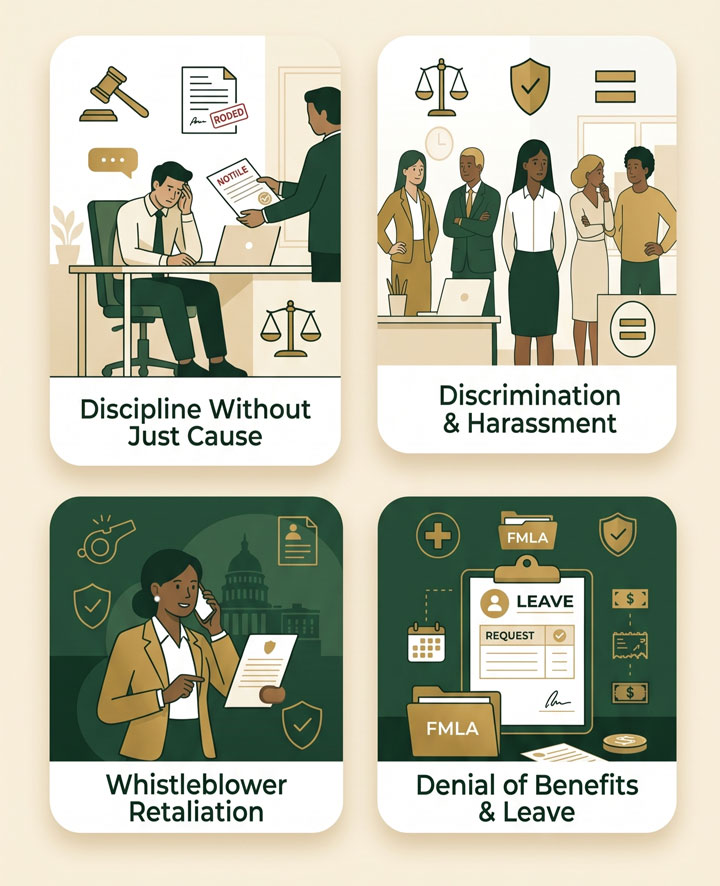
Many public employees — particularly classified civil service employees and those covered by collective bargaining agreements — can only be disciplined or terminated for just cause. This means the employer must have a legitimate, documented reason for the discipline and must follow proper procedures. When a public employer imposes discipline that is disproportionate to the offense, fails to follow progressive discipline policies, or bases the discipline on false or unsupported allegations, the grievance process provides a mechanism to challenge the action and seek reversal.
Whistleblower Retaliation
Public employees who report waste, fraud, abuse, safety violations, or other illegal conduct by their government employers are protected by both federal and state whistleblower statutes. Despite these protections, retaliation against government whistleblowers is common. The grievance process, combined with statutory whistleblower claims, provides multiple avenues for challenging retaliatory conduct. West Virginia's Patient Safety Act provides specific whistleblower protections for healthcare workers who report safety concerns.
Discrimination and Harassment
Public employees experiencing workplace discrimination or harassment based on protected characteristics can pursue remedies through both the grievance process and external agencies such as the EEOC, the West Virginia Human Rights Commission, or the Ohio Civil Rights Commission. In many cases, the most effective strategy involves pursuing both tracks simultaneously — the grievance process for immediate workplace relief and the agency complaint or lawsuit for damages.
Denial of Benefits and Leave
Public employees are typically entitled to specific leave and benefit packages established by statute, regulation, or collective bargaining agreement. Grievances commonly arise when employers deny accrued annual leave or sick leave, refuse FMLA leave or fail to restore the employee to their position after leave, change benefit structures retroactively, or improperly calculate seniority, pay rates, or leave accruals. These disputes often involve interpretation of complex statutory provisions and policy language, making legal representation valuable.
Helpful Shorts From Our TikTok
Klie Law Office F.A.Q
1. What should I do immediately after a personal injury accident?
After a personal injury accident, your safety comes first. Seek medical attention right away, even if you feel fine, as some injuries may not be immediately apparent. If possible, document the scene by taking photos, gathering witness information, and filing an accident report. Then, contact an experienced personal injury attorney at Klie Law Offices to discuss your rights and next steps.
2. How do I know if I have a valid personal injury claim?
If you were injured because of someone else’s negligence or reckless actions, you may have a valid personal injury claim. Common situations include car accidents, slip and falls, workplace injuries, and dog bites. Our attorneys offer free consultations to review your situation and determine whether you have a case.
3. How much is my personal injury case worth?
The value of a personal injury case depends on several factors, including the severity of your injuries, medical expenses, lost wages, pain and suffering, and long-term impacts on your life. Every case is unique, so we carefully evaluate the details to pursue the maximum compensation available under the law.
4. Will my personal injury case go to court?
Most personal injury cases are settled outside of court through negotiations with insurance companies or at mediation. However, if a fair settlement cannot be reached, Klie Law Offices is prepared to represent you in court and fight for the compensation you deserve.
5. How much does it cost to hire a personal injury lawyer at Klie Law Offices?
Klie Law Offices handles personal injury cases on a contingency fee basis. This means you pay no upfront costs, and we only get paid if we recover compensation for you. Your initial consultation is free, and we’ll explain all fees and terms clearly before you decide to move forward.

Civil Litigation Team
Civil Litigation Attorneys







Administrative Assistant

Civil Litigation Paralegals



Civil Litigation Practice Coordinator

Civil Litigation Law Clerk


Why Legal Representation Matters
Public employee grievance proceedings may be administrative rather than judicial, but they are adversarial — the employer will typically be represented by legal counsel or experienced human resources professionals, and the outcome can determine whether you keep your job, your benefits, and your career. An experienced attorney can evaluate whether your grievance has merit and identify all available legal theories, ensure you meet all filing deadlines (which are strictly enforced), gather and preserve evidence including documents, witness statements, and personnel records, prepare you for testimony and cross-examination, present your case effectively at the Grievance Board hearing, and protect your rights on appeal if necessary.
Many public employees attempt to navigate the grievance process without legal representation, only to discover that procedural missteps, missed deadlines, or inadequate evidence presentation have undermined an otherwise meritorious claim. Engaging an attorney early in the process — ideally before filing the initial grievance — gives you the best chance of a successful outcome.
Why Choose Klie Law Offices
Public employee grievances require attorneys who understand government employment law, civil service protections, collective bargaining frameworks, and the specific procedures of the West Virginia Public Employees Grievance Board and Ohio's public employment systems. At Klie Law Offices, our employment law team has extensive experience representing public employees at every stage of the grievance process — from initial filing through Grievance Board hearings and appeals. We serve public employees across West Virginia and Ohio, including state agency workers, county and municipal employees, public school teachers and staff, higher education employees, law enforcement personnel, and healthcare workers in public facilities.

Facing an Unfair Employment Action by a Government Employer?
If you are a public employee who has been disciplined, terminated, denied benefits, or subjected to discrimination or retaliation, the grievance process provides a powerful mechanism to fight back — but strict deadlines apply. Contact Klie Law Offices for a free case evaluation, or schedule an appointment online. We serve clients from our offices in Buckhannon, Clarksburg, Morgantown, and Parkersburg in West Virginia, and Canton in Ohio.
Office Locations
Buckhannon
21 E Main St, Suite 160
Buckhannon, WV 26201
Map and Directions ↗
Parkersburg
300 Star Avenue, Unit 312
Parkersburg, WV 26101
Map and Directions ↗
Clarksburg
339 W Main St
Clarksburg, WV 26301
Map and Directions ↗
Morgantown
1300 Fort Pierpont Dr, Suite
102, Morgantown, WV 26508
Map and Directions ↗
Canton, OH
4150 Belden Village St NW
Suite 606
Canton OH, 44718
Map and Directions ↗
The first thing you’ll notice when you come to our Law Offices is that we’ll listen to your story. We want to know what you’re going through and what you need. Then, we’ll explain how West Virginia law applies to your specific situation and what your legal options are. There are no cookie-cutter answers here. We create a legal strategy tailored to each client’s individual needs.
Depending on your situation, we will find the right path forward. We are adept at resolving your legal matters through negotiation and mediation whenever possible. But we also won’t hesitate to take your case to trial if that’s what it takes to get the best possible outcome for you.
If you’re facing a legal challenge and need someone in your corner, don’t wait to get the help you deserve. Contact Klie Law Offices today to schedule a confidential consultation and take the first step toward a solution that works for you.