
SALARIED EMPLOYEES RIGHTS









Salaried Employee Rights in West Virginia and Ohio
Many workers assume that being paid a salary means they are not entitled to overtime pay, extra compensation for long hours, or the same protections that hourly workers enjoy. That assumption is wrong — and employers know it. Misclassifying employees as exempt salaried workers to avoid paying overtime is one of the most common wage violations in the country. At Klie Law Offices, our employment law attorneys help salaried employees throughout West Virginia and Ohio understand their rights and recover the compensation they are owed.
We handle salaried employee cases from our offices in Buckhannon, Clarksburg, Morgantown, Parkersburg, and Canton, Ohio.
Salaried Does Not Automatically Mean Exempt
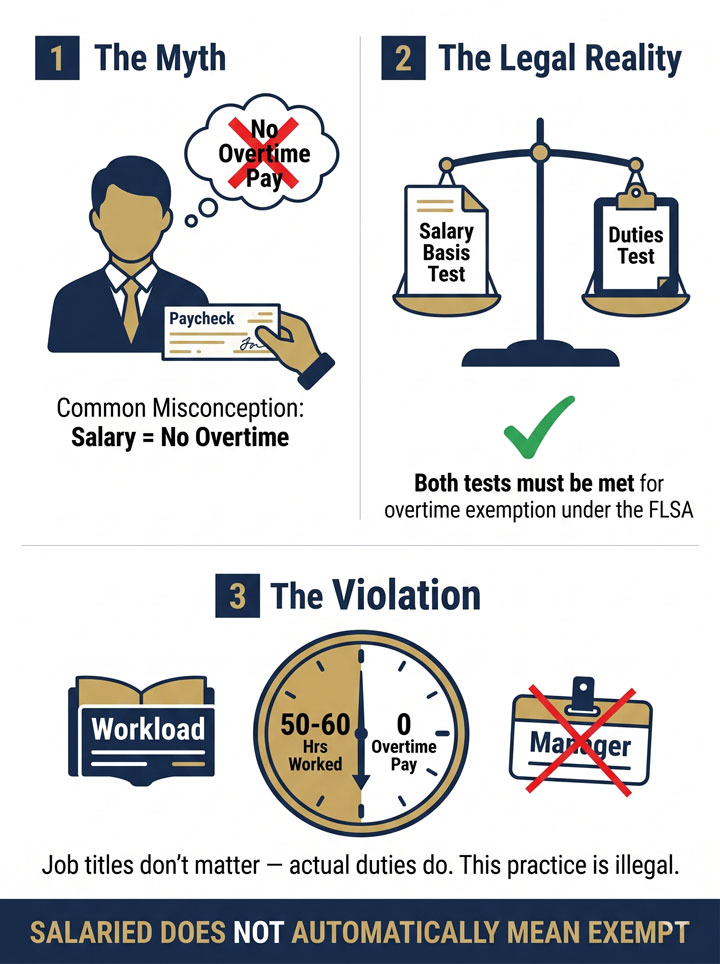
This is the single most important thing every salaried employee needs to understand. Being paid a salary is only one of the requirements for an overtime exemption. To be legally exempt from overtime under the Fair Labor Standards Act, an employee must meet both a salary basis test and a duties test. Failing either test means the employee is non-exempt and entitled to overtime pay for all hours worked over 40 in a workweek — regardless of the fact that they receive a salary.
Employers frequently exploit this misunderstanding by putting employees on salary, giving them a title like "manager" or "coordinator," and then working them 50 or 60 hours a week without overtime. If the employee's actual job duties do not qualify for an exemption, this practice is illegal.

The Salary Basis Test
To qualify for the white-collar exemptions (executive, administrative, or professional), an employee must be paid on a salary basis at a rate that meets the minimum threshold set by the Department of Labor. Being paid on a salary basis means the employee receives a predetermined, fixed amount each pay period that is not reduced based on the quality or quantity of work performed. If the employer docks the employee's pay for partial-day absences, for working fewer hours than expected, or for other reasons related to the quality or quantity of work, the salary basis requirement may be violated — which would make the employee non-exempt and entitled to overtime for all overtime hours worked during the period the improper deductions occurred.
There are limited exceptions that allow salary deductions without destroying the salary basis, including deductions for full-day absences for personal reasons (not sickness or disability), full-day absences for sickness or disability under a bona fide plan, unpaid disciplinary suspensions of one or more full days for serious workplace conduct violations, and FMLA leave.
The Duties Tests
Even if the salary test is met, the employee must also perform job duties that qualify under one of the specific exemption categories. The analysis focuses on what the employee actually does — not their job title, job description, or how the employer classifies them.
Executive Exemption
The executive exemption applies to employees whose primary duty is managing the enterprise or a recognized department or subdivision, who regularly direct the work of two or more other employees, and who have the authority to hire or fire other employees (or whose recommendations on hiring, firing, and promotion are given particular weight). A "manager" who spends the majority of their time performing the same duties as their subordinates — stocking shelves, serving customers, processing orders — does not qualify for this exemption regardless of their title.
Administrative Exemption
The administrative exemption applies to employees whose primary duty is performing office or non-manual work directly related to the management or general business operations of the employer or the employer's customers, and whose primary duty includes the exercise of discretion and independent judgment with respect to matters of significance. This is the most commonly misapplied exemption. Employees who follow established procedures, apply standard criteria, or carry out routine tasks generally do not exercise the level of discretion required for this exemption, even if their work involves some decision-making.

Professional Exemption
The professional exemption covers two categories. The learned professional exemption applies to employees whose primary duty is work requiring advanced knowledge in a field of science or learning, customarily acquired through a prolonged course of specialized intellectual instruction — such as licensed physicians, lawyers, engineers, and accountants. The creative professional exemption applies to employees whose primary duty requires invention, imagination, originality, or talent in a recognized field of artistic or creative endeavor.
Other Exemptions
Additional exemptions exist for certain outside sales employees, highly compensated employees meeting a higher salary threshold, and certain computer employees. Each has its own specific criteria that must be satisfied.
Client Reviews










Day one, I was treated very nicely and worn respect . My attorney, Ally was absolutely amazing and I am so thankful she was my attorney . Ally kept me informed, and always had my best interest at heart. I would absolutely recommend her.
. She had my back the whole time during my divorce process and fought for me all the way through. She made the divorce process so smooth and easy for me . I would recommend Klie Law, 100%, to anyone looking for great representation during the very stressful time of going through a divorce . I am reallly really appreciative of everything that was done for me. Don't have words to tell you how much I love this firm!!! Happy Holidays!!


When I first started, I had no idea where to begin, what steps to take, or who to turn to. Thankfully, I found Alysson Fleenor, Ethan Herrick, and the rest of the legal team at Klie Law, and I couldn't have asked for better guidance.
They were not only professional and efficient but also incredibly patient and communicative every step of the way. They made sure everything moved smoothly and without unnecessary delays or complications. Honestly, I was surprised at how quickly things progressed, but that’s a testament to how well they handled my case.
The team truly took care of me, and I felt supported the entire time. I would absolutely recommend Klie Law to anyone in need of legal representation, especially if you’re looking for a team that offers clear communication, genuine care, and a steady hand to help you through such a life-changing transition. Even if you just need help finding direction during a difficult time, Klie Law is where I’d send you.


Thanks to her efforts, the case was resolved in my favor, far exceeding my expectations. I felt supported, respected, and confident throughout the entire process.
If you’re looking for a lawyer who combines intellect, integrity, and heart, look no further. I wholeheartedly recommend Kimberly Koslski to anyone in need of outstanding legal representation.





Gabby is very knowledgeable and will fight for what you want in the courtroom!
Jennifer and Katie are always quick to respond to any question or concern you may have.
I would definitely use Klie Law for any other service in the future..
An added bonus is their friendly, helpful, always willing to help receptionist, Tammy. She will help you get your questions answered as soon as possible.


Gabby knows her stuff! Super thorough and organized with a hint of sass in the court room. She fights for you and what you want!
Jennifer and Katie are always quick to respond and knowledgeable and if they're unsure, they find out quickly.
If you're looking for a team for your custody case this is it!


Nicole, was also exceptional. She was responsive, organized, and went above and beyond to ensure everything was handled efficiently. She made sure I was informed every step of the way, which made the entire process much smoother.
I highly recommend Klie Law Offices for anyone in need of legal services. Their team is top-notch and I felt completely supported throughout the entire process.







Gigi


Google presented me with four--five Law Firms. After researching and deciphering through reviews, I decided to try Klie Law Office, in West Virginia, my home State!
On my way to my scheduled appointment for case evaluation, I thought to myself, " Will they be willing to accept my case, knowing that my next hearing is in 8 days?" I was Hoping and Praying to my Father, who is beside me with every step of my path, all the way there!
When Iris and I met, we exchanged a firm handshake, and she professionally introduced herself!
To me, a firm handshake means something. Our ( myself, two sisters and one brother) Dad taught us at a young age, a firm handshake means something! To each of us we will know what he means, when our day comes, to experience it!
My day had come, this day! What did I get from her firm handshake? A welcoming first impression of strength and confidence!
We discussed details of my case, and she would inform me of their processes, which member of the team does what, the retainer amount, paperwork process, and they would be there for my hearing, that was now 7 days away!
After processing my retainer, filling out necessary forms, I left with self confidence knowing that Klie Law accepted my case, and they will be fighting For Me, Not Against Me, as in the past 7-8 months.
Thank You, Klie Law!



Common Misclassification Scenarios
Certain job categories are particularly susceptible to misclassification. Assistant managers and team leads who spend most of their time performing the same work as their teams are often misclassified as exempt executives. Office coordinators, administrative assistants, and bookkeepers are often misclassified under the administrative exemption even though their duties are routine rather than involving significant discretion. Paralegals, technicians, and junior-level professionals are sometimes misclassified under the professional exemption even though they do not possess the advanced degree or specialized training required. And IT support staff and help desk technicians may be misclassified under the computer employee exemption even though their work does not involve systems analysis, programming, or software engineering at the level required by the regulations.
Rights That Apply to All Salaried Employees
Regardless of whether a salaried employee is exempt or non-exempt from overtime, all salaried employees retain fundamental workplace protections. Every salaried worker is protected against workplace discrimination based on protected characteristics, sexual harassment and hostile work environment, retaliation for engaging in protected activities, unsafe working conditions, and violations of FMLA rights. Being classified as exempt does not waive these protections, and salaried employees should not hesitate to assert these rights.
What to Do If You Think You Are Misclassified
If you are a salaried employee working more than 40 hours a week without overtime pay, you should evaluate whether your job duties genuinely qualify for an exemption. Consider what you actually spend most of your time doing each day — not what your job description says, but what you actually do. Ask yourself whether you truly manage other employees, exercise significant discretion, or perform work requiring advanced specialized education. If your daily work looks more like what the hourly employees around you are doing, you may be misclassified.
Keep detailed records of your hours worked, your actual job duties, and any instances where your employer docked your salary improperly. Consult with an employment attorney who can evaluate your specific situation and determine whether you have a claim for unpaid overtime.

Helpful Shorts From Our TikTok
Klie Law Office F.A.Q
1. What should I do immediately after a personal injury accident?
After a personal injury accident, your safety comes first. Seek medical attention right away, even if you feel fine, as some injuries may not be immediately apparent. If possible, document the scene by taking photos, gathering witness information, and filing an accident report. Then, contact an experienced personal injury attorney at Klie Law Offices to discuss your rights and next steps.
2. How do I know if I have a valid personal injury claim?
If you were injured because of someone else’s negligence or reckless actions, you may have a valid personal injury claim. Common situations include car accidents, slip and falls, workplace injuries, and dog bites. Our attorneys offer free consultations to review your situation and determine whether you have a case.
3. How much is my personal injury case worth?
The value of a personal injury case depends on several factors, including the severity of your injuries, medical expenses, lost wages, pain and suffering, and long-term impacts on your life. Every case is unique, so we carefully evaluate the details to pursue the maximum compensation available under the law.
4. Will my personal injury case go to court?
Most personal injury cases are settled outside of court through negotiations with insurance companies or at mediation. However, if a fair settlement cannot be reached, Klie Law Offices is prepared to represent you in court and fight for the compensation you deserve.
5. How much does it cost to hire a personal injury lawyer at Klie Law Offices?
Klie Law Offices handles personal injury cases on a contingency fee basis. This means you pay no upfront costs, and we only get paid if we recover compensation for you. Your initial consultation is free, and we’ll explain all fees and terms clearly before you decide to move forward.

Civil Litigation Team
Civil Litigation Attorneys







Administrative Assistant

Civil Litigation Paralegals



Civil Litigation Practice Coordinator

Civil Litigation Law Clerk


Damages for Misclassification
Salaried employees who have been misclassified as exempt may be entitled to recover all unpaid overtime wages for up to two years (or three years for willful violations), liquidated damages equal to the unpaid overtime amount, and attorney's fees and costs. These claims can also be brought as collective actions on behalf of all similarly situated employees, which can be powerful when an employer has applied the same misclassification across an entire category of workers. Employers who retaliate against employees for raising misclassification concerns face additional liability.
West Virginia and Ohio Considerations
West Virginia's overtime statute generally follows the FLSA framework, applying the same exemption criteria and salary thresholds. West Virginia's strong public policy exception to at-will employment provides additional protection for employees who challenge their classification or assert overtime rights. Ohio likewise follows the federal framework for overtime exemptions and provides its own statutory remedies for wage violations through wage and salary dispute claims. Our Canton office attorneys are well-versed in Ohio-specific wage and classification rules.
Why Choose Klie Law Offices
Misclassification cases require attorneys who understand the detailed FLSA exemption criteria and can analyze whether an employee's actual duties meet the legal standard. At Klie Law Offices, our employment law team has extensive experience evaluating exempt classifications, calculating unpaid overtime, and pursuing recovery for misclassified salaried employees in West Virginia and Ohio. We examine the real-world duties of each client — not just the employer's paperwork — and fight to recover the full compensation our clients have earned.


Salaried but Working Without Overtime Pay?
If you are a salaried employee working long hours without overtime compensation, you may be misclassified and entitled to significant back pay. Contact Klie Law Offices for a free case evaluation, or schedule an appointment online. We serve clients from our offices in Buckhannon, Clarksburg, Morgantown, and Parkersburg in West Virginia, and Canton in Ohio.
Office Locations
Buckhannon
21 E Main St, Suite 160
Buckhannon, WV 26201
Map and Directions ↗
Parkersburg
300 Star Avenue, Unit 312
Parkersburg, WV 26101
Map and Directions ↗
Clarksburg
339 W Main St
Clarksburg, WV 26301
Map and Directions ↗
Morgantown
1300 Fort Pierpont Dr, Suite
102, Morgantown, WV 26508
Map and Directions ↗
Canton, OH
4150 Belden Village St NW
Suite 606
Canton OH, 44718
Map and Directions ↗
The first thing you’ll notice when you come to our Law Offices is that we’ll listen to your story. We want to know what you’re going through and what you need. Then, we’ll explain how West Virginia law applies to your specific situation and what your legal options are. There are no cookie-cutter answers here. We create a legal strategy tailored to each client’s individual needs.
Depending on your situation, we will find the right path forward. We are adept at resolving your legal matters through negotiation and mediation whenever possible. But we also won’t hesitate to take your case to trial if that’s what it takes to get the best possible outcome for you.
If you’re facing a legal challenge and need someone in your corner, don’t wait to get the help you deserve. Contact Klie Law Offices today to schedule a confidential consultation and take the first step toward a solution that works for you.